For first-time dog people
Help your puppy get used to a crate, toothbrushing and everyday life
Spoil Your Everyday · 3 October 2026
General guidance from the sources linked below; adapt it to your dog.
A carrier, brush or toothbrush is more useful when your dog recognises it as an ordinary part of life. A few calm introductions now can make future care less unfamiliar—for your dog and for you.
 The goal is familiarity
Short, positive practice. Plenty of time to rest.
Start early when you can, move at your dog’s pace and keep practising gently as they grow. An adult dog can learn too; you may simply need smaller steps and more patience.
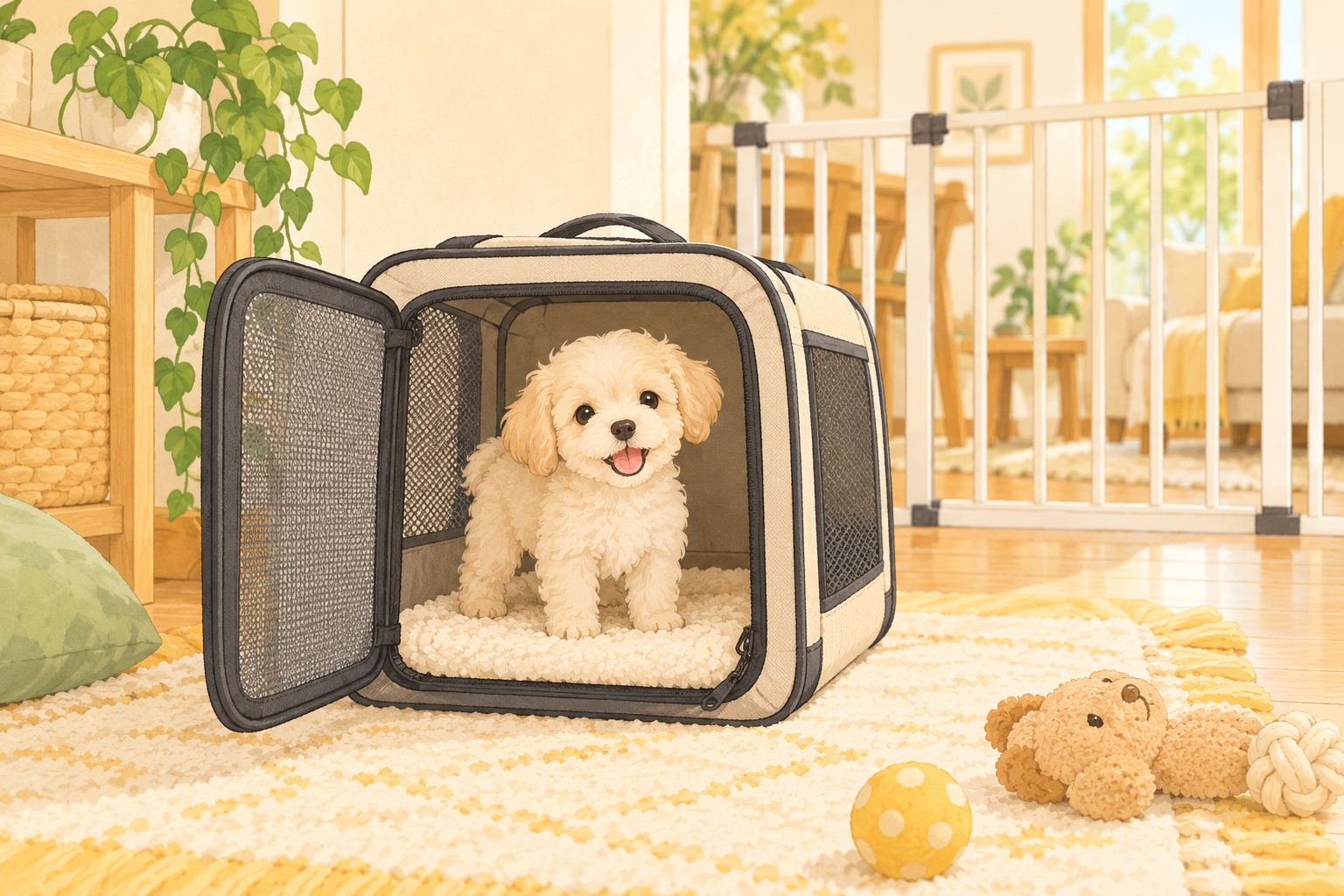
A crate or carrier should feel comfortable before you need it
Choose enough usable space to stand naturally, turn around and lie comfortably. Do not buy an undersized crate to make it feel cosy. Comfortable bedding and a quiet position can make the space inviting without restricting movement.
- Secure the door open and let your dog investigate voluntarily.
- Reward a calm approach or entry; let them come back out.
- Build up relaxed time inside before briefly moving or closing the door.
- Increase duration gradually, only while they remain comfortable. Go back a step if they show distress.
Never use the crate as punishment or leave a dog to panic inside. A travel carrier is not an all-day living space. RSPCA crate guidance.
Why practise before travel, boarding or a hospital stay?
If a future journey or veterinary admission involves a carrier or kennel, familiarity with resting behind a door may make one part of the experience less novel. It does not guarantee a stress-free stay. Ask the clinic or boarding provider what accommodation they use, and practise relevant handling and short visits where possible. A familiar washable mat may help if they allow it.
For equipment measurements and a practical shopping list, see our first-puppy shopping list.
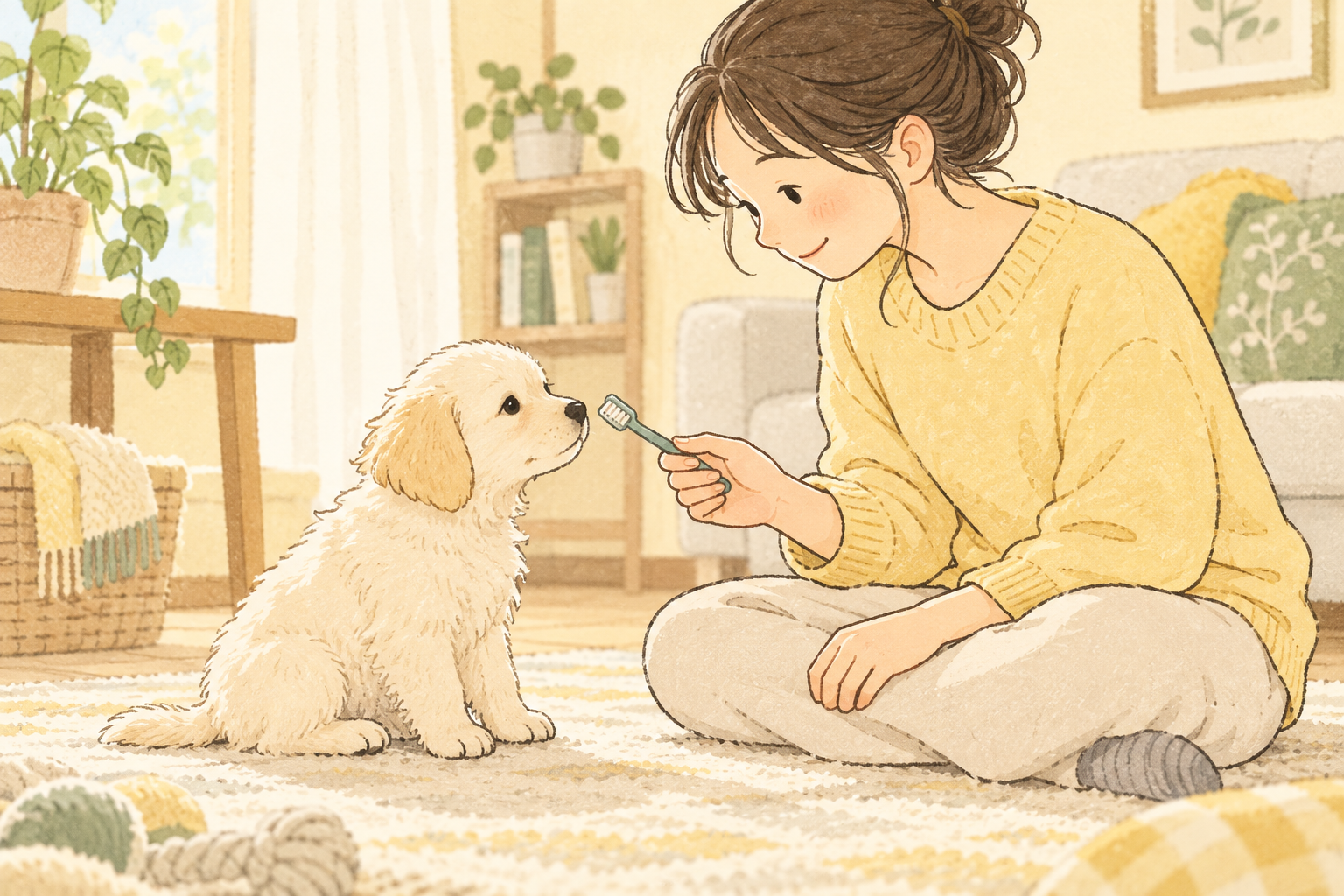
Toothbrushing: introduce the routine before it becomes urgent
The Royal Veterinary College advises starting young to improve acceptance. Begin with comfortable handling around the muzzle and brief lip lifting, then introduce dog toothpaste and a suitable soft brush gradually. Reward small steps and stop before it turns into a struggle. Use toothpaste made for dogs, not human toothpaste. RVC dental advice.
An older dog is not a lost cause. If handling seems painful, their mouth is sore or they strongly resist, ask your vet before continuing. The aim is a sustainable care routine, not forcing a full brushing session on day one.
Socialisation is learning that everyday life is safe
Positive early experiences with people, sounds, surfaces and suitable dogs can help build confidence. Socialisation does not mean meeting every dog or being passed between strangers. Watch from a comfortable distance, reward relaxed behaviour and allow your puppy to move away. Discuss safe outings during the vaccination period with your vet. Blue Cross socialisation guidance.
Think about your real life: a lift in your building, the sound of a hairdryer, a towel after a wet walk, a car carrier, or someone briefly looking at an ear. Introduce one manageable experience at a time instead of a packed day of new things.
“A tired dog is a happy dog”—with an important qualification
Activity matters, but exhaustion is not the target. The University of Illinois veterinary behaviour team explains that this familiar saying misses the wider needs of dogs. Aim for appropriate exercise, sniffing, play, learning and undisturbed rest. University of Illinois guidance.
Puppies need substantial rest and can become overstimulated. Match activity to age, health and the individual: a French Bulldog and a Border Collie do not automatically need the same outing, and breed alone is not an exercise prescription. If your puppy cannot settle, adding another energetic game is not always the answer. Blue Cross puppy guidance.
Toilet opportunity → suitable activity → a little practice → quiet rest.
This is a flexible sequence, not a fixed timetable. Check food, water, company and comfort too. A camera can show what happens when you step away; it cannot meet those needs for you.
What should you buy for this?
Start with a comfortable resting space, washable bedding, suitable toys and basic grooming tools. Spend on good fit and easy cleaning. The repeated, positive experiences are the part no product can do for you. our first-puppy shopping list